
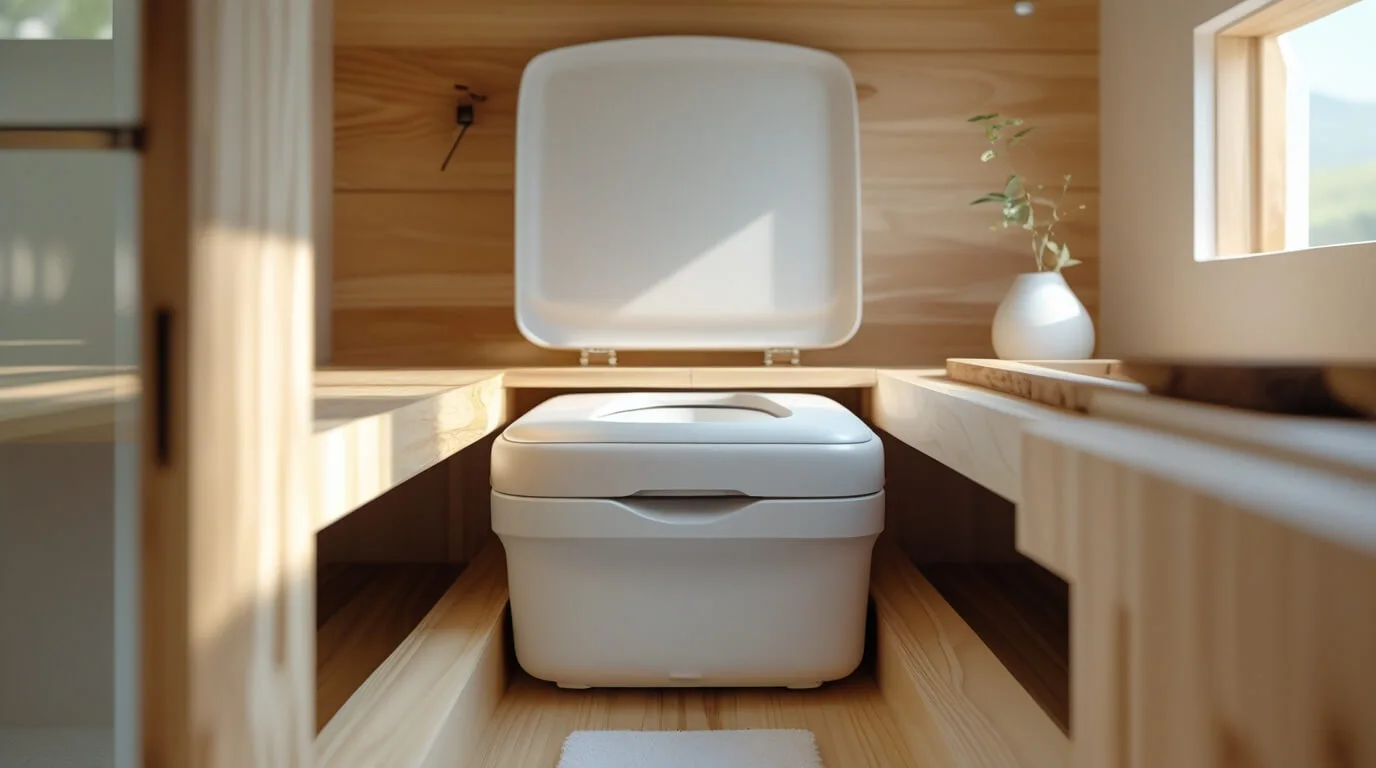
⚡ Quick Answer: How does a composting toilet work? A composting toilet works by creating a controlled aerobic environment where bacteria and fungi break down human waste into a stable, humus-like material. The process relies on four variables: oxygen supply, moisture (40–60%), temperature (68–113°F / 20–45°C), and a carbon-to-nitrogen ratio of 30:1. Active systems add forced-air ventilation and low-wattage heating to optimize these conditions, reducing waste volume by up to 90% — with no water or sewer connection required.
Jump to: The Microbiology | Active vs. Passive Systems | Chemical Balance
Table of Contents
If you’re curious about composting toilet science, the answer lies in the same biological processes that have cycled organic matter through ecosystems for millions of years. The engineering challenge isn’t inventing something new, but creating the right conditions for biology to work safely and reliably inside a sealed household system.
Conventional flush toilets are surprisingly resource-intensive, accounting for up to 30% of household water use. Composting toilets take a different approach—treating human waste as a biological resource and transforming it through controlled aerobic decomposition into a stable soil amendment.
The Microbiology of Decomposition
To understand how a composting toilet works at a fundamental level, you have to start with the organisms doing the actual work. Decomposition is not a single chemical reaction — it’s a cascading sequence of metabolic events carried out by distinct communities of microorganisms.
The Primary Decomposers
Three microbial groups drive the aerobic breakdown of waste inside a composting chamber:
- Heterotrophic bacteria — fast-colonizing organisms that consume simple sugars and nitrogen compounds in the early stages of decomposition
- Actinomycetes — bacteria that specialize in breaking down complex proteins and cellulose; their activity produces the characteristic earthy aroma of finished compost
- Saprophytic fungi — attack harder structural materials, reducing particle size and increasing surface area available to bacterial populations
These are aerobic organisms — they require oxygen. When oxygen is displaced by moisture or compaction, anaerobic bacteria take over and produce methane and hydrogen sulfide: the odors associated with septic systems and pit latrines. Good composting toilet engineering exists specifically to prevent this from happening.
The Mesophilic Window: Temperature as the Master Variable
Most residential composting toilet systems operate in the mesophilic temperature range of 68°F to 113°F (20°C to 45°C), where microbes break down waste efficiently. Below this range, microbial activity slows; above it, thermophilic bacteria dominate, which requires more heat than household systems typically provide.
Many composting toilets use small heating elements—about 540W for roughly 6 hours per day—to maintain this range during colder periods. This modest energy use is minimal compared to the water and wastewater infrastructure conventional toilets require.
“Composting toilets don’t eliminate waste — they redirect it back into the biological cycles it was always meant to feed.”
Pathogen Attenuation: Why Active Systems Matter
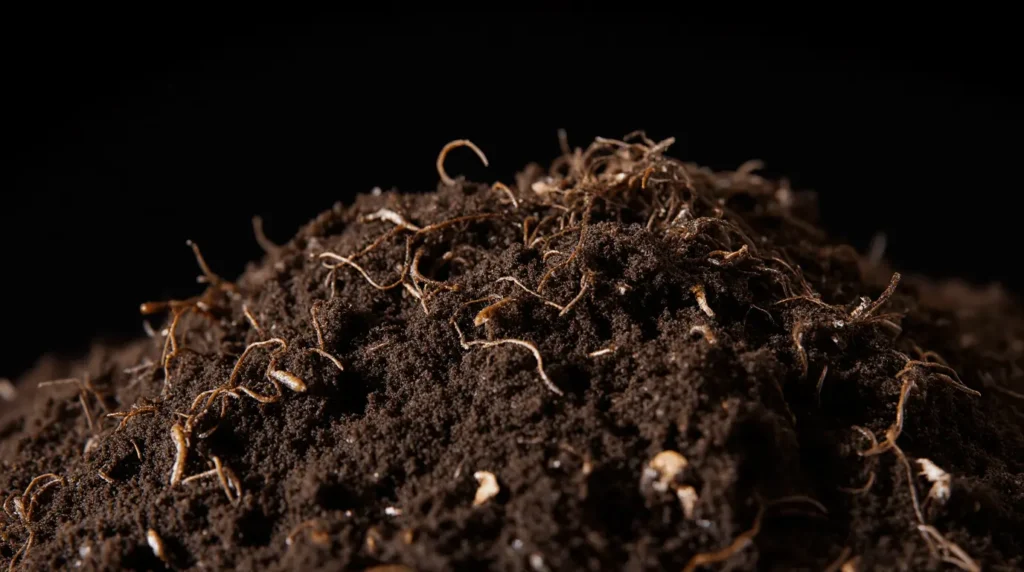
Human feces contain pathogens: bacteria such as Salmonella and E. coli, viruses, and parasitic cysts. Their reduction to safe levels is the performance benchmark that separates credible composting toilet designs from inadequate ones. Active systems — which regulate both temperature and oxygen — significantly outperform passive designs on pathogen reduction. Slow or moldering systems cannot guarantee equivalent pathogen elimination and are generally unsuitable for regulatory compliance contexts.
Active vs. Passive Architectures: How Composting Toilets Work in Practice
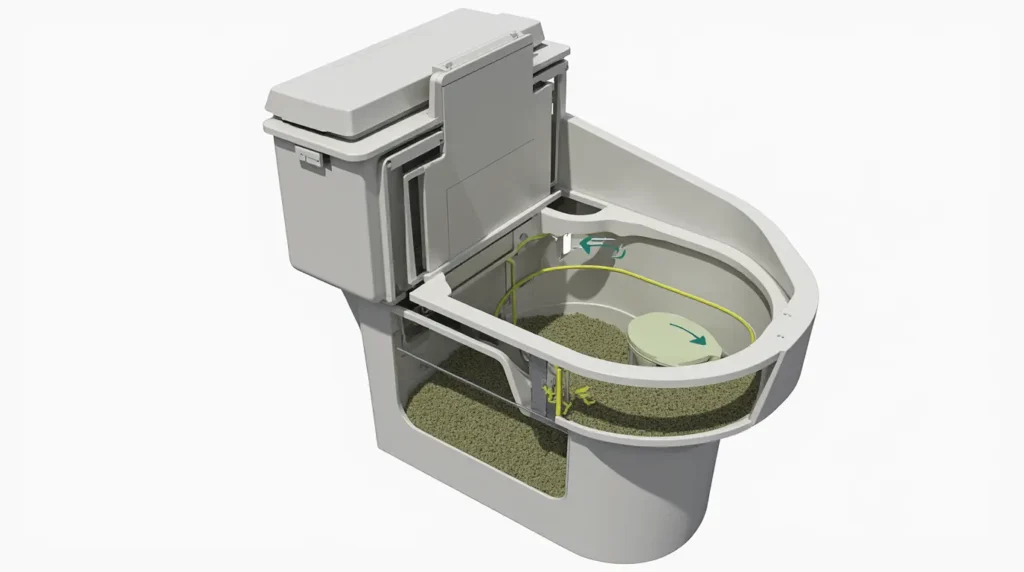
Not all composting toilets work the same way. They exist on a spectrum of complexity and reliability — broadly divided into passive (slow) and active systems. 📌 Core Engineering Principle: All composting toilet design optimizes four variables simultaneously — oxygen availability, moisture (40–60%), temperature (68–113°F), and carbon-to-nitrogen ratio (30:1). Every design decision serves this goal.
Passive (Slow) Systems
The simplest composting toilets — often called moldering privies — rely entirely on ambient conditions and extended retention time, sometimes measured in years. They require no electricity, have minimal moving parts, and function adequately at low usage rates. Their key limitation: without regulated aeration or temperature, decomposition is slower and less complete, and pathogen elimination is variable. These systems are not appropriate for high-frequency residential use or regulated installation contexts.
Active Systems: Engineered Decomposition
Active composting toilets integrate two critical components: a forced-air ventilation system and, in many models, a low-wattage heating element. The ventilation fan — typically drawing 80–150W, comparable to a standard light bulb — continuously draws fresh oxygen into the composting chamber while expelling moisture-laden air. This maintains aerobic conditions and creates a slight negative pressure in the chamber, preventing odors from migrating into the living space.
Self-Contained vs. Central System Configurations
Active composting toilets further divide into two configurations:
- Self-contained units — the composting reactor sits directly beneath the toilet bowl; suitable for 1–2 users in intermittent-use settings such as cabins, RVs, or off-grid dwellings
- Central (remote) systems — a large-volume reactor is installed separately (typically in a basement) and can accept connections from multiple toilet seats; offer greater biological stability and longer maintenance intervals
Bulking Agent Selection: The Carbon Equation
Every composting toilet requires regular addition of a carbon-rich bulking agent. Human feces carry a C:N ratio of approximately 5–10:1; aerobic composting requires 30:1. Without carbon supplementation, the system becomes nitrogen-saturated, generating ammonia and suppressing aerobic bacteria. Beyond chemistry, bulking agents create physical air pockets throughout the composting mass — structural porosity that maintains oxygen diffusion.
| Bulking Agent | Carbon Content | Moisture Absorption | Best Application |
|---|---|---|---|
| Sawdust (untreated) | High | High | Residential; widely available and low cost |
| Coconut coir | Moderate–High | Very High | Humid climates; premium active systems |
| Peat moss | High | High | Traditional choice; sustainability concerns |
| Wood shavings | High | Moderate | Large-volume central system reactors |
Chemical Management: The Urine Problem and Its Solution
The human body produces 0.8 to 2 liters of urine per day against approximately 450g of solid feces. This volumetric imbalance is the central chemical challenge in composting toilet design. Urine entering the composting chamber simultaneously elevates moisture toward saturation — killing aerobic bacteria by displacing oxygen — and increases nitrogen loading, collapsing the C:N ratio far below the functional threshold.
Urine Diversion Technology
Modern composting toilet design has converged on urine diversion as the definitive solution. Urine-diverting bowls — identifiable by a forward separator or dual-chamber design — route liquid waste to a separate collection vessel while solid waste drops into the composting reactor. The downstream benefits operate simultaneously:
- Moisture control — the composting chamber remains within the aerobically optimal 40–60% moisture range
- Odor elimination — the primary cause of composting toilet odor is anaerobic conditions from excess moisture; diversion eliminates the cause rather than treating the symptom
- Nutrient recovery — collected urine, diluted 10:1 with water, functions as a complete liquid fertilizer containing plant-available nitrogen, phosphorus, and potassium
- Extended maintenance intervals — redirecting the majority of waste volume dramatically reduces how frequently the solid chamber requires servicing
“Urine diversion is arguably the single highest-impact design decision in residential composting toilet engineering — solving odor, moisture, and nitrogen overload simultaneously.”
Environmental Impact: What Changes When the Flush Goes Away

Understanding how a composting toilet works biologically is the first step. Its real value appears at the systems level.
A single composting toilet can save over 6,600 gallons (24,984 liters) of water per person per year. It also reduces groundwater contamination risks and allows nutrient recovery by converting waste into a soil amendment known as humanure (use depends on local regulations).
- Up to 90% volume reduction of solid waste in active systems
- 6,600+ gallons of water saved per person per year
- Zero subsurface discharge — eliminating groundwater contamination risk
- Finished compost contains plant-available N, P, and K for soil amendment
Professional Standards: NSF Certification and System Sizing
For any residential or commercial installation, NSF/ANSI Standard 41 certification is the independent benchmark for verified system performance. Certified composting toilets have been independently evaluated for pathogen reduction, structural integrity, and compost output quality. For any regulated application, NSF certification is a minimum specification — not an optional upgrade.
Sizing Guidelines
Under-sizing is the most common installation mistake. Biological stability is directly proportional to composting volume. A larger mass maintains more stable temperature, moisture, and pH, and is far more resilient under high-frequency use. When in doubt, size up.
- Self-contained units — 1–2 persons, intermittent use: weekend cabins, seasonal residences, off-grid dwellings
- Central system configurations — full-time residential or multi-occupancy buildings where performance consistency and low maintenance are priorities
- Institutional/commercial systems — automated central reactors with aeration monitoring for parks, visitor centers, and public-access facilities
Conclusion: From Waste Stream to Resource Stream
A composting toilet works because biology — given the right conditions of oxygen, moisture, temperature, and carbon balance — is extraordinarily efficient at transforming organic matter. The science is well-established. The engineering to support it has matured. What remains is a shift in perspective: from treating human waste as a liability to recognizing it as a misplaced biological resource. For environmental engineers, ecological designers, and technically-minded homeowners, the composting toilet is one of the most practical expressions of circular economy principles available at the household scale. NSF-certified systems have answered the performance question definitively. The remaining question is whether we are willing to reconsider the infrastructure assumptions that have defined sanitation for the past 150 years.
Take Action Today
- Subscribe to our Newsletter – Receive expert tips, case studies, and exclusive content on sustainable technology and green materials