
By Nouha Allaoui, Environmental Engineer, Published Feb 21, 2025, Updated May 5, 2026
Water Treatment · 9 min read / 🎧 Audio version available
🚨 The EPA sets 500 ppm as the maximum for drinking water — but many household taps in the US test above that, and you can’t taste, smell, or see the difference. This guide shows you exactly how to check yours and what to do about it.
⚡ Total Dissolved Solids) measures everything dissolved in your water — minerals, salts, heavy metals, and more. The ideal drinking water range is 50–300 ppm. Anything above 500 ppm needs investigation: it could be harmless minerals, or it could be lead, arsenic, or nitrates
Jump to: TDS Water Quality Chart | TDS Calculator | Best Filtration Methods.
🎧 Prefer to listen? Play the 4-minute audio version while you follow along.
Table of Contents
What Is TDS in Water?
TDS stands for Total Dissolved Solids — every substance dissolved in your water that passes through a filter but cannot be seen with the naked eye. Think minerals, salts, metals, and trace organic material all invisibly suspended in every glass you drink.
TDS is measured in parts per million (ppm) or milligrams per liter (mg/L) — these units are identical. A reading of 200 ppm means 200 milligrams of dissolved material per liter of water.
Where Does Total Dissolved Solids Come From?
Dissolved solids enter your water from two main sources:
Human-made sources: Industrial runoff, agricultural chemicals and fertilizers, aging pipes and plumbing, road salt, urban runoff
Natural sources: Minerals from soil and rock (calcium, magnesium, potassium), underground aquifers, limestone deposits
TDS Water Quality Chart: What Your Levels Mean
| TDS Level (ppm) | Water Quality | What It Means |
|---|---|---|
| 0 – 50 | Excellent | Minimal dissolved solids; may lack beneficial minerals |
| 50 – 300 | Good | Optimal range for drinking water; balanced mineral content |
| 300 – 500 | Acceptable | Slight taste changes possible; still safe for most uses |
| 500 – 900 | Fair | Noticeable mineral presence; filtration recommended |
| 900 – 1200 | Poor | Likely unsafe; significant taste issues; treatment needed |
| 1200+ | Unacceptable | High contamination risk; requires immediate treatment |
📋 EPA Guideline: The U.S. Environmental Protection Agency recommends a maximum of 500 ppm for drinking water. This is a secondary standard — it affects taste and appearance, not a hard safety enforcement threshold.
⚠️
Critical warning: Heavy metals like lead and arsenic are dangerous at very low concentrations but may barely move your Total Dissolved Solids number. A low reading does not guarantee safe water. Use TDS as a screening tool, not a final safety verdict.
How to Measure TDS: Using a TDS-Meter
What is a TDS-Meter?
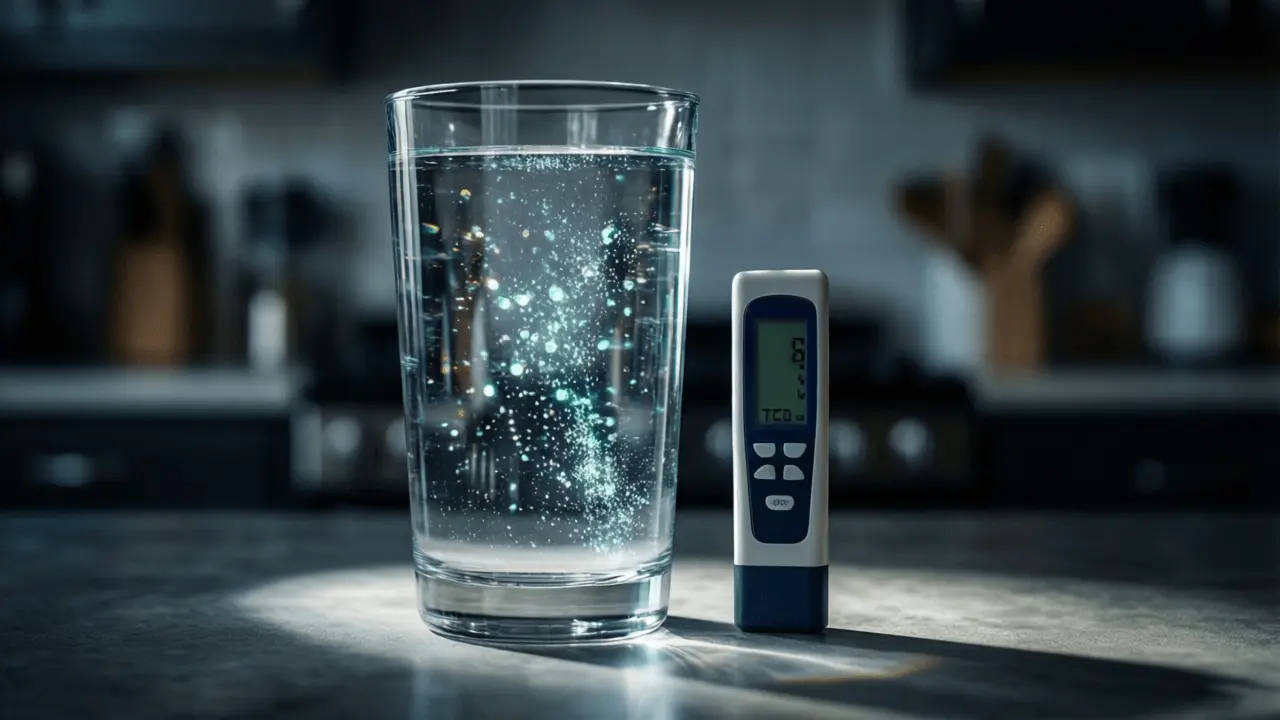
A TDS-meter is an affordable, handheld device that estimates dissolved solid concentrations by measuring water’s electrical conductivity. More ions = higher conductivity = higher reading.
Step-by-Step Testing Guide
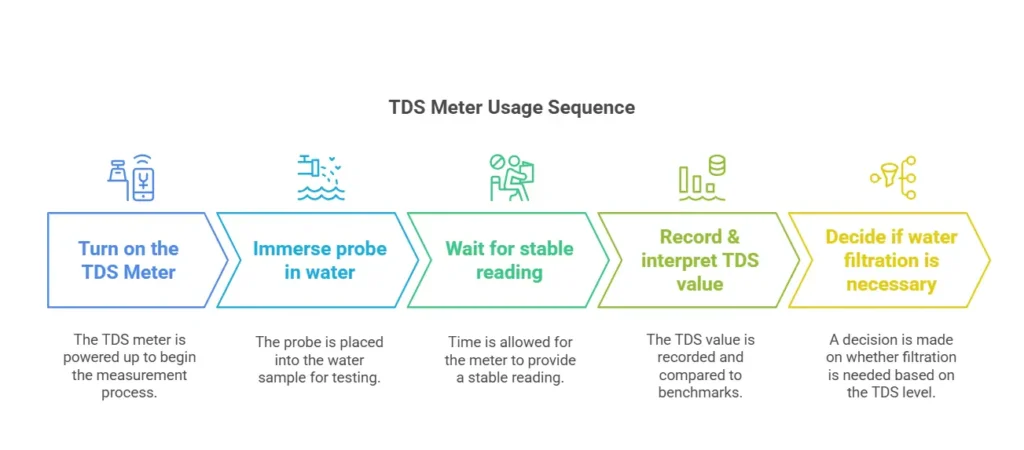
- Calibrate your device – Follow manufacturer instructions for accurate readings
- Fill a clean glass with water at room temperature
- Remove the protective cap from the meter probe
- Immerse the probe 2-3 inches into the water
- Wait 10-15 seconds for the reading to stabilize
- Record your measurement and compare to the quality chart above
- Rinse the probe with distilled water after use
💡What TDS-meters can’t do: They cannot identify specific contaminants, detect uncharged substances like pesticides or pharmaceuticals, or distinguish between safe minerals and dangerous toxins. For complete safety, pair the testing with an annual lab analysis.
Total Dissolved Solids Calculator & Water Quality Interpreter
Use this Total Dissolved Solids calculator to determine the ideal total dissolved solids levels for different water uses, from drinking and cooking to aquariums and industrial applications. Simply enter your reading to understand if your water meets the recommended standards and whether filtration or adjustments are needed. Ensure your water quality is safe and optimized for your needs!
TDS CalculatorWhy TDS Levels Matter for Your Health
Not all dissolved solids are equal. The same reading of 400 ppm could represent two very different situations:
Scenario B: Industrial runoff containing lead, nitrates, or arsenic — a serious health risk
Scenario A: Naturally occurring calcium and magnesium — beneficial minerals, safe to drink
Understanding what contributes to your reading helps you choose appropriate treatment:
Key Health Concerns by Contaminant
| Contaminant | Source | Health Risk | TDS Impact |
|---|---|---|---|
| Lead | Old pipes, solder | Neurological damage, especially in children | Barely raises — won’t be caught by a meter |
| Arsenic | Natural deposits, industrial pollution | Carcinogenic at low concentrations | Minimal increase |
| Nitrates | Agricultural runoff | Blue baby syndrome risk in infants | Moderate increase |
| Calcium/Magnesium | Groundwater, limestone | Generally safe — can cause hard water | Significantly raises |
| Sodium | Water softeners, road salt | Blood pressure concerns at high levels | Significantly raises |
Critical Point: Heavy metals like lead and arsenic are extremely dangerous but may not significantly raise TDS levels. This is why comprehensive water testing beyond Total Dissolved Solids measurement is essential.
Best Water Filters for High TDS — Which One Do You Need?
The right filter depends on why your TDS is high. Here’s a clear comparison:
| Filter Type | TDS Reduction | Best For | Cost |
|---|---|---|---|
| Reverse Osmosis ★ Best | 90–99% | Above 500 ppm, heavy metals, all contaminants | $200–$500 |
| Distillation | 95–99% | Small volumes, emergency use | $100–$400 |
| Ion Exchange (Softener) | 30–50% | Hard water (high calcium/magnesium only) | $400–$2,500 |
| Activated Carbon | <10% | Taste/odor improvement, chlorine removal | $20–$200 |
How to Choose:
- TDS above 500 ppm → Reverse osmosis is your best option
- Hard water, scale buildup → Ion exchange / water softener
- Taste issues, Total Dissolved Solids is fine → Activated carbon filter
- Multiple concerns → RO + carbon combination system
💧Note on RO systems: They remove nearly everything — including beneficial minerals. Many premium RO systems include a remineralisation stage to add calcium and magnesium back, keeping you in the ideal 50–150 ppm range.
How Often Should You Test Your Water?
- Monthly: Quick Total Dissolved Solids check with your meter; visual check for cloudiness
- Quarterly: Test before and after your filter to verify performance
- Annually: Full laboratory analysis for specific contaminants (lead, arsenic, nitrates)
- Immediately: After any plumbing work, local water quality alerts, or sudden taste/odor changes
The Future of Water Quality Management
Emerging technologies are revolutionizing how we monitor and treat water:
Smart Water Monitoring
- Real-time TDS sensors connected to smartphone apps
- Automatic alerts when levels exceed safe thresholds
- Usage tracking to predict filter replacement needs
- Integration with smart home systems
Sustainable Filtration Innovations
- Zero-waste RO systems that recycle reject water
- Solar-powered purification for off-grid applications
- Bio-based filters using natural materials
- Energy-efficient systems reducing operational costs
Advanced Testing Methods
- Portable spectrometers identifying specific contaminants
- DNA-based sensors detecting biological threats
- AI-powered analysis predicting water quality trends
- Blockchain verification for water quality transparency
Frequently Asked Questions About TDS
Is low TDS water safe to drink?
Yes, but very low Total Dissolved Solids (below 50 ppm) means water lacks beneficial minerals like calcium and magnesium. Some studies suggest that long-term consumption of very low mineral water can have health implications, though evidence is not conclusive. For best results, aim to keep the 50-300 ppm range.
Can I drink water with high TDS?
Water with a Total Dissolved Solids between 300-500 ppm is safe but may taste unpleasant. If it’s over 500 ppm, you’ll want to investigate what’s behind the elevation — if it’s harmful impurities like lead or nitrates, the water is not safe regardless of the overall TDS level.
Why is there still TDS in my filtered water?
Most filters (except RO and distillation) don’t remove all dissolved solids. Carbon filters only treat organic compounds and chlorine. Some TDS is actually desirable for taste and health — completely pure water tastes flat and may be lacking in beneficial minerals.
How frequently should I test my water?
Test monthly using a TDS-meter for routine monitoring. Perform detailed lab testing once a year, or sooner if you see sudden variations in taste, odor, color, or Total Dissolved Solids levels. Test after significant plumbing repairs or local water events as well.
Conclusion: Taking Charge of Your Water Quality
Total Dissolved Solids is one of the most useful — and most misunderstood — measures of water quality. Here’s what actually matters:
- The ideal range is 50–300 ppm for drinking water
- Above 500 ppm: don’t panic, but investigate what’s in the water
- A TDS-meter is a screening tool, not a safety guarantee — pair it with annual lab testing
- Reverse osmosis is the most effective way to reduce high Total Dissolved Solids
- Very low TDS (<50 ppm) isn’t ideal either — some minerals are good for you
A $20 TDS-meter and one annual lab test will tell you more about what you’re drinking than almost anything else. That’s a small investment for a lot of peace of mind.
About the Author
Dr. Nouha Allaoui
Environmental Engineer · Water Quality Specialist · 8+ years in sustainable water systems
Nouha holds a PhD degree in Environmental Engineering and has spent 8 years working on water treatment systems across residential and industrial applications. She writes to make water science accessible and actionable for homeowners.
Take Action Today
📧 Subscribe to our Newsletter – Get expert tips on sustainable water treatment, real-world case studies, and practical solutions delivered monthly.